
Gavin Grimmer















Father and Son #2 Report (Jesse Miller)
"Around 7:40pm on the 9th of August 1981 my son Brian and I had just finished eating
when we heard the loud noise of an engine is the distance. We both looked around
but could not see anything but the noise was getting closer. Brian said Dad what's
that. It appeared to be a plane doing stunts. It was side to side up and down and
had very a bright light on the front of it and every so often the light would hit
the ground where we were. Finally it turned south- east and dropped behind a ridge
in the distance. I didn't think much else of it. When we looked the next morning
it looked like Chichester ridge from where we were. I learnt a day later when we
got home that a plane had crashed up there and when they said around Carey's peak
I just thought I could of been wrong about what I seen. Maybe the ridge was further
back. I reported what I had seen to Dungog police and they told me they would look
in to it. We were both camped about 1.2km west of Cherry tree road up on a ridge.
From the 7th to the 11th of that month."
Note in both of these Reports above, that
they saw a very bright light (obviously the landing light) and the second report
even gave the position of this light... on the front. Many planes have the landing
light/s out on the leading edge of the wings – even later model Cessna 210’s did,
but MDX had it’s landing lights in it’s nose bowl... on the front.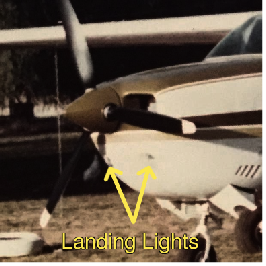 Landing lights
are nearly always set up with one light pointing directly out in front of the plane
with the second one pointed downwards a little to illuminate the ground immediately
in front of the plane when taxiing, and also to enable the pilot to still see the
runway ahead with a high nose attitude when the plane is flared just before touch
down
Landing lights
are nearly always set up with one light pointing directly out in front of the plane
with the second one pointed downwards a little to illuminate the ground immediately
in front of the plane when taxiing, and also to enable the pilot to still see the
runway ahead with a high nose attitude when the plane is flared just before touch
down
Hence, the reason why the statements, “One minute the lights are on us then they
point away again” and, “every so often the light would hit the ground where we were”
initially I thought was nonsense, but on further reflection I came to realise that
this did not mean the nose of the aircraft was positioned in a dive, but was simply
the plane was further out in the valley besides these ridges (most likely a little
higher) and the glow of the light would flash across the witness positions as the
plane was being thrown around twisting and turning in the very turbulent air that
would have been present in that valley... due to the strong wind flowing over the
ridge. Not only that, the fact that the light shone on the upwind ridges whilst the
plane was traversing down that valley, showed that Mike was controlling the plane
by offsetting the drift by pointing the nose that way (crabbing along).
Report #1 said it, “It headed south to Ben near Cherry Tree Road” and the ‘Ben’ mentioned
here is a peak known as “Big Ben Mountain”. 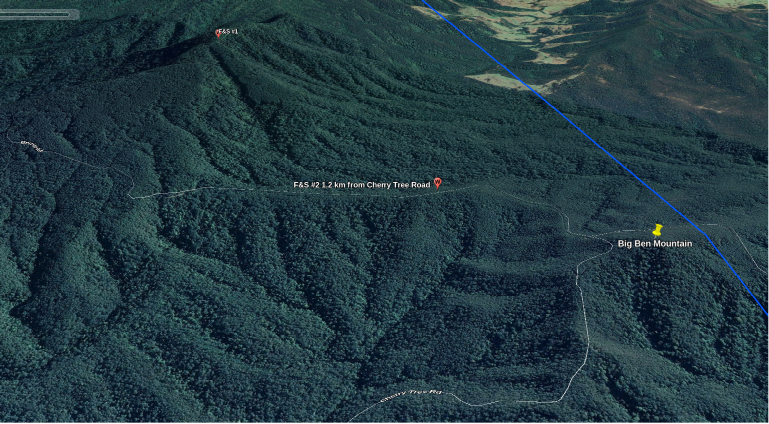
From the observation point of F&S #2, they could see down into the Monkerai Valley and strangely they said it turned south-east and dropped behind a ridge in the distance (inferring that it had descended?), yet then said that in the daylight next morning, it looked like the Chichester Ridge. Chichester Ridge is much further west and cannot be seen from that position which surely indicates they had a problem over knowing the name of the ridge?
You’ll note I have drawn this track going past Big Ben Mountain on the eastern side as this will become apparent as we move on....
Don Readford / Operation Phoenix – Mrs Boydell / Craven


MDX pg 50